
How Social Media Marketing Can Help You Reach More Customers
 can help create a professional destination for users who arrive through social media. **H7: Why Strong Calls to Action Matter** A social media post should have a clear purpose. When the objective is to encourage an action, the audience should understand what to do next. Calls to action can encourage users to visit a website, contact the business, request a quote, book an appointment, send a message, or learn more about a service. Without a clear next step, social media content may generate attention without producing meaningful business opportunities. **H8: How Social Media Marketing Can Generate Leads** Social media can contribute to lead generation when several elements work together. These include relevant content, audience targeting, compelling offers, calls to action, landing pages, and an effective follow-up process. Businesses can use social media to demonstrate expertise, answer customer questions, explain their services, showcase results, and introduce potential customers to their solutions. However, businesses should not expect every post to generate an immediate sale. Social media is often part of a longer customer journey that begins with awareness and develops through engagement, research, trust, and eventually conversion. Intuition Digital Solutions' [social media marketing services](https://intuitionds.co.uk/services/social-media-marketing/) focus on strategy, content planning, creative direction, platform management, community management, and performance monitoring. **H9: How Social Media Engagement Builds Customer Relationships** One major advantage of social media is direct communication. Customers can comment on posts, send messages, ask questions, respond to stories, and share content. Businesses can use these interactions to understand customer concerns and provide useful information. Responding to comments and messages can also help remove questions or objections that might otherwise prevent a customer from taking action. Community management is therefore an important part of social media marketing. Social media should not be treated only as a publishing platform. It can also become a communication channel between a business and its audience. **H10: How Different Content Formats Expand Your Reach** Different content formats can attract different types of users. Businesses can use short-form videos, images, carousels, stories, educational posts, promotional content, customer testimonials, industry insights, and behind-the-scenes content. The objective should not be to use every format simply because it is available. Each format should have a purpose within the overall marketing strategy. Educational content can demonstrate expertise. Product demonstrations can explain benefits. Customer-focused content can build trust. Promotional content can encourage action. A balanced content strategy can therefore help businesses address different stages of the customer journey. ## FAQs About Social Media Marketing ### 1. What is social media marketing? Social media marketing involves using social media platforms to promote a business, communicate with audiences, distribute content, build brand awareness, and support business objectives. ### 2. Can social media help small businesses reach more customers? Yes. Small businesses can use social media to increase visibility, demonstrate expertise, communicate their services, and reach relevant audiences. ### 3. Which social media platform is best for a business? There is no single platform that works best for every business. The right platform depends on the target audience, industry, content type, and business objectives. ### 4. How often should a business post on social media? There is no universal posting frequency. Businesses should choose a schedule they can maintain consistently while keeping content useful and relevant. ### 5. Can social media generate leads? Yes. Social media can contribute to lead generation through relevant content, targeted campaigns, strong calls to action, landing pages, and effective follow-up. ### 6. What type of content should businesses publish? Businesses can publish educational, informative, promotional, visual, customer-focused, industry-related, and entertaining content depending on their audience and goals. ### 7. Is social media marketing useful for local businesses? Yes. Local businesses can use social media to build awareness, showcase services, communicate with local audiences, answer questions, and encourage potential customers to contact them. ### 8. Should social media content link to a website? When appropriate, yes. Links can direct interested users to service pages, blog articles, landing pages, product information, and contact forms. ### 9. How long does social media marketing take to produce results? There is no fixed timeframe. Individual posts can generate immediate engagement, while building consistent brand awareness and an audience generally requires ongoing effort. ### 10. Why is a social media strategy important? A strategy gives businesses direction. It helps organize content, identify suitable platforms, maintain consistency, target relevant audiences, and measure performance. ## FINAL THOUGHTS Social media marketing can help businesses reach more customers by increasing visibility, communicating with relevant audiences, distributing valuable content, and building stronger relationships. However, simply posting regularly is not enough. Businesses need a clear strategy, consistent content, appropriate platforms, effective messaging, audience engagement, and performance monitoring. Social media works best when it is connected to the rest of the digital marketing strategy. It can support website traffic, SEO, branding, lead generation, and customer communication. With the right approach, social media can become a valuable channel for attracting potential customers and supporting sustainable business growth. ## CTA: Reach More Customers With a Strategic Social Media Presence If your business is struggling to maintain consistent social media activity or is not generating meaningful results from its current strategy, professional social media management can provide structure and direction. [Explore Intuition Digital Solutions](https://intuitionds.co.uk/) to learn more about social media marketing, website development, SEO, and digital marketing services designed to help businesses strengthen their online presence.](https://intuitionds.co.uk/wp-content/uploads/2026/09/How-Social-Media-Marketing-Can-Help-You-Reach-More-Customers-1024x572.webp)
Social media has become one of the most accessible ways for businesses to reach potential customers, build brand awareness, and communicate directly with their target audience. Platforms such as Facebook, Instagram, LinkedIn, and TikTok give businesses opportunities to showcase their products, services, expertise, and brand personality.
However, simply creating social media accounts and posting occasionally is not enough. Effective social media marketing requires a clear strategy, relevant content, consistent communication, audience research, and regular performance analysis.
When managed correctly, social media marketing can help businesses increase visibility, attract relevant audiences, generate enquiries, drive website traffic, and develop stronger relationships with customers.
Why Local Businesses Are Investing in Modern Website Design to Attract More Customers

A professional website has become an essential marketing asset for local businesses. Customers increasingly search online before contacting a company, visiting a physical location, or purchasing a service. This shift has encouraged local businesses to invest in modern website design to attract more customers, build credibility, improve visibility, and compete effectively.
A modern business website is more than an attractive homepage. It combines responsive design, clear messaging, intuitive navigation, fast performance, useful content, and strong calls to action. When these elements work together, a website can become a powerful tool for generating enquiries and supporting long-term business growth.
How Businesses Can Use ChatGPT SEO to Drive Digital Growth

ChatGPT SEO is changing how businesses approach search visibility, content creation, keyword research, and online customer discovery. As search behavior evolves, businesses need more than traditional keyword placement to attract the right audience. They need useful, well-structured, relevant content that can satisfy both search engines and users who increasingly rely on AI-powered tools to discover information.
By combining traditional SEO principles with ChatGPT-assisted strategies, businesses can produce content more efficiently, identify valuable search opportunities, improve website structure, and build a stronger digital presence. The key is not simply using ChatGPT to generate articles, but using it strategically as part of a broader SEO process.
Why Digital Marketing Is Essential for Growing Your Business Online

Digital marketing has become an essential part of modern business growth. As more customers use search engines, social media, websites, email, and online marketplaces to discover and evaluate businesses, having a strong digital presence is no longer optional. Digital marketing helps businesses reach relevant audiences, build brand awareness, generate leads, increase website traffic, and create opportunities for long-term growth. Whether you run a small local company, an eCommerce store, or a growing service-based business, the right digital marketing strategy can help you compete more effectively in an increasingly connected marketplace.
Is AI-Generated Content Bad for SEO and Search Rankings?

At IntuitionDS, we understand that AI-generated content has changed the way brands approach content marketing. Businesses can now research topics, create drafts, organize ideas, and produce content much faster than before. But with that convenience comes an important question: Is AI-generated content bad for SEO and search rankings?
The short answer is no—not simply because AI was used to create it. Search engines are primarily concerned with the quality, usefulness, relevance, originality, and trustworthiness of content. The real problem begins when businesses publish large amounts of low-quality, repetitive, inaccurate, or unhelpful AI content without meaningful human review or expertise.
AI can be a powerful content-production tool, but it should not replace strategy, expertise, research, editing, and quality control. When used correctly, AI can support an effective SEO strategy. When used carelessly, it can produce content that fails to satisfy users and may perform poorly in search results.
How 10 Benefits of a Website Can Turn Your Brand Into a Digital Authority
A website is more than a digital address for your business. When strategically designed, it can become the foundation of your brand’s authority, credibility, visibility, and growth. Customers increasingly research businesses online before making decisions, which means your website often becomes the place where they decide whether your brand deserves their attention and trust.
A strong website can educate visitors, demonstrate expertise, showcase customer results, generate qualified leads, and establish your business as a reliable source of information. However, these benefits do not happen simply because a company has a website. They come from creating a website with a clear purpose, valuable content, strong user experience, and consistent brand messaging.
Here are 10 important ways a strategic website can help turn your brand into a digital authority.
Why AI Is Set to Become the Most Important Marketing Tool for Small Businesses in 2027

Why is AI becoming such a powerful force in small-business marketing? The answer goes far beyond writing blog posts or generating social media captions. AI is changing how businesses research customers, create campaigns, analyze data, personalize communication, manage leads, and make marketing decisions.
For small businesses, this shift is particularly important. Large companies can hire entire teams for marketing, sales, analytics, content, advertising, and customer support. Small businesses usually have to achieve similar goals with fewer people and tighter budgets. AI can close part of that gap by giving small teams access to capabilities that previously required significant time, money, and manpower.
By 2027, AI is likely to become less of an optional marketing experiment and more of an essential business capability.
Why AI Search Is Reshaping SEO in 2027 and How Brands Can Stay Visible
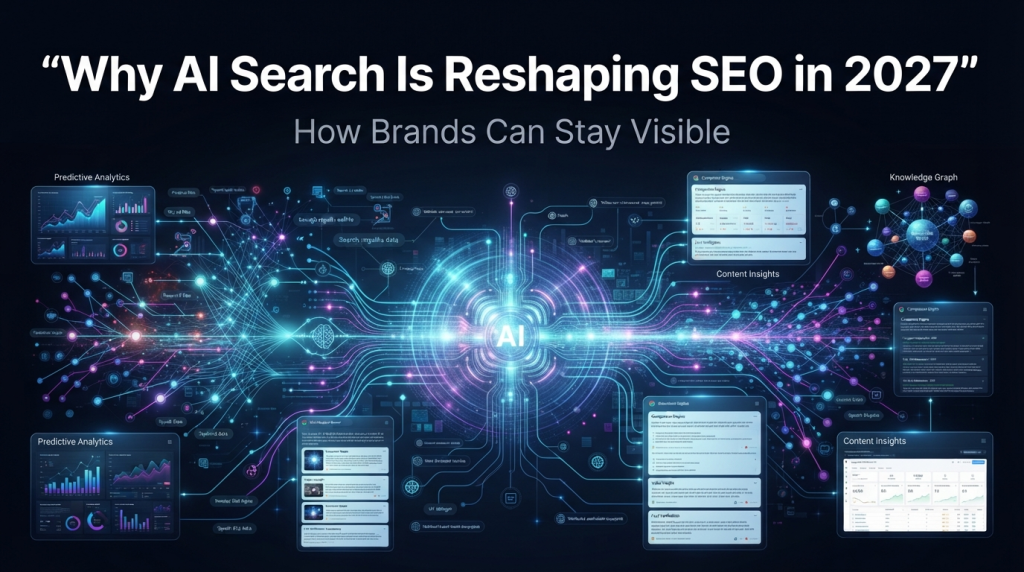
AI search is changing how people discover information, businesses, products, and services. Instead of relying only on traditional search results, users can now receive direct, AI-generated answers. As this technology develops, brands will need to adapt their SEO strategies to remain visible and competitive in 2027.