
Menu
How to Build Brand Consistency Across Your Website and Social Media
Building a recognizable brand requires more than an attractive logo or a well-designed website. Your business needs a consistent identity across every digital touchpoint, including your website, social media profiles, advertisements, and marketing content. When your brand uses the same visual elements, tone of voice, messaging, and personality across platforms, customers can recognize your business more easily and develop greater confidence in your services.
Brand consistency also helps businesses communicate their values, differentiate themselves from competitors, and create a more professional customer experience. Whether you operate a small business, an e-commerce store, or a digital marketing agency, establishing clear brand guidelines can make your marketing more effective. This guide explains how to build brand consistency across your website and social media using practical strategies that support long-term business growth.
1. What Is Brand Consistency and Why Does It Matter?
Brand consistency means presenting your business with a recognizable identity across all customer interactions. It includes your visual design, brand voice, messaging, values, and overall customer experience. Every platform should communicate the same core identity, even when the content format changes.
For example, if your website uses professional language, a specific color palette, and clean visual layouts, your social media content should reflect those same characteristics. A sudden shift to unrelated colors, inconsistent logos, or a completely different tone can confuse your audience.
Consistency does not mean publishing identical content everywhere. Instead, it means maintaining a unified identity while adapting content to the requirements of each platform. This helps your business remain recognizable while communicating effectively with different audiences.
2. Define Your Brand Identity Before Creating Content
The first step toward brand consistency is defining what your business represents. Your brand identity should explain your purpose, the customers you serve, the problems you solve, and the qualities that differentiate your business from competitors.
Start by documenting your mission, core values, target audience, and brand personality. Decide whether your brand should appear professional, innovative, approachable, authoritative, or creative. These characteristics should influence your website copy, social media captions, advertisements, and customer communications.
For example, a premium consulting firm may use a confident, professional tone, while a lifestyle brand may communicate through conversational language and expressive visuals. Both approaches can work, provided they accurately reflect the business.
3. Identify Your Target Audience and Brand Positioning
Your brand should communicate in a way that resonates with your intended customers. Research their needs, preferences, challenges, and expectations before deciding how your business should present itself online.
Identify what makes your business different and communicate that value consistently. If your primary advantage is personalized service, your website and social media should repeatedly demonstrate responsiveness, expertise, and customer-focused solutions.
Clear positioning prevents your brand from sending conflicting messages. It also helps your marketing team create content that attracts relevant customers rather than trying to appeal to everyone.
4. Create a Brand Style Guide for Visual Consistency
A brand style guide documents the visual and verbal standards that keep your marketing consistent. It acts as a reference for employees, designers, copywriters, social media managers, and external marketing partners.
Your guide should include the following elements:
Logo usage: Specify approved logo variations, minimum sizes, clear space, and incorrect applications.
Brand colors: Define primary and secondary colors using HEX or RGB codes for digital use.
Typography: Select approved fonts for headings, body text, buttons, and promotional graphics.
Imagery: Establish standards for photography, illustrations, iconography, and graphic styles.
Brand voice: Define your tone, preferred vocabulary, and writing principles.
Messaging: Document your tagline, value proposition, key messages, and calls to action.
Keep the guide practical and accessible. A concise document that your team consistently follows is more useful than a lengthy manual that nobody references.
A professional website design service can help translate these guidelines into a cohesive digital experience.
Image placement: Insert a premium brand identity visual showing a coordinated logo system, color palette, typography samples, website interface, and matching social media templates. Use a clean digital design aesthetic with no unnecessary decorative elements.
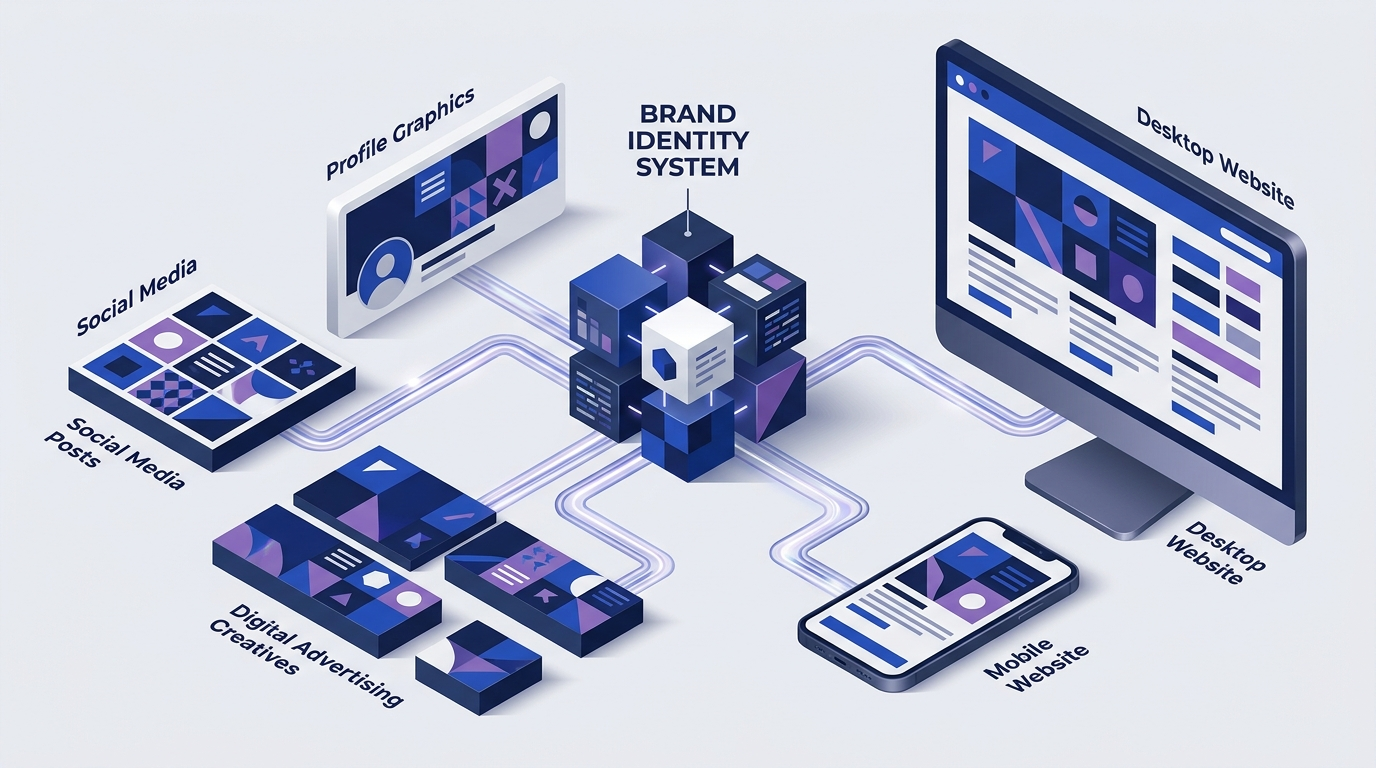
5. Align Your Website Design with Your Brand Identity
Your website is often one of the first places potential customers evaluate your business. It should communicate the same identity that customers encounter on your social media profiles.
Start by applying your approved color palette, typography, logo placement, button styles, and image treatments throughout the website. Keep navigation, spacing, layouts, and page structures consistent so visitors can move between sections without experiencing a different visual identity on each page.
Your website content should also reinforce your positioning. Headlines, service descriptions, testimonials, and calls to action should use language that reflects your brand personality.
Pay attention to mobile responsiveness. A visually consistent desktop website is not enough if its mobile version has unreadable text, distorted images, or poorly arranged elements.
Review important pages, including your homepage, service pages, contact page, and blog. Each should feel like part of the same brand experience.
6. Maintain Consistent Branding Across Social Media Platforms
Social media platforms have different audiences, formats, and content requirements, but your brand should remain recognizable across all of them.
Use your approved logo or brand mark for profile images where appropriate. Maintain consistent colors, typography, image treatments, and messaging in cover images, posts, stories, reels, and promotional graphics.
Create reusable templates for recurring content formats such as educational posts, customer testimonials, service promotions, announcements, and industry insights. Templates reduce production time and prevent unnecessary design variations.
However, do not copy the exact same post onto every platform without considering context. LinkedIn may require a more business-focused presentation, while Instagram may benefit from stronger visual storytelling. Adapt the format and wording while preserving your core brand identity.
A coordinated social media marketing strategy can help your business maintain consistent publishing standards and a recognizable online presence.
7. Develop a Consistent Brand Voice and Messaging Strategy
Visual consistency is only one part of branding. Your written communication must also sound like it comes from the same business.
Establish clear guidelines for tone, sentence structure, vocabulary, technical terminology, and calls to action. Decide how formal or conversational your brand should be and whether it uses humor, storytelling, or educational explanations.
Create a messaging framework that includes your main value proposition, key benefits, brand promises, and frequently used phrases. This helps different team members communicate the same message without making every post sound identical.
For example, a business that positions itself as a trusted digital marketing partner should publish useful advice, explain its services clearly, and avoid exaggerated promises about guaranteed rankings or instant growth.
Review website copy, social media captions, email campaigns, and advertisements regularly. Consistent messaging helps customers understand what your business offers and why it deserves their attention.
8. Use a Content Calendar and Reusable Brand Templates
A content calendar makes brand consistency easier to maintain because it organizes what your business publishes, where it appears, and who is responsible for it.
Plan content around business objectives, audience needs, seasonal opportunities, and relevant industry topics. Assign each post a clear purpose, such as educating customers, building trust, demonstrating expertise, or generating leads.
Organize your calendar around a few recurring content pillars:
1. Educational content: Share practical advice, tutorials, and industry insights.
2. Brand authority: Publish case studies, original research, and professional expertise.
3. Customer proof: Highlight authentic testimonials, reviews, and project results.
4. Service promotion: Explain your offerings, benefits, and suitable use cases.
5. Brand culture: Communicate your mission, team values, and working approach.
Use approved templates and a pre-publication checklist to confirm that each post follows your brand guidelines. Review content before publishing to catch inconsistent colors, incorrect logos, outdated information, and messaging that does not match your positioning.
9. Monitor Brand Consistency and Improve It Over Time
Brand consistency requires ongoing management. As your business grows, different employees, campaigns, and platforms can introduce inconsistencies unless you regularly review them.
Conduct a quarterly brand audit covering your website, social media profiles, advertisements, and other customer-facing channels. Check whether visual assets follow your guidelines, messaging reflects your positioning, and contact information remains accurate.
Track relevant business metrics, including branded search activity, website engagement, social media reach, qualified leads, and conversion rates. These metrics help you evaluate marketing performance, although no single metric proves that brand consistency alone caused an improvement.
Collect customer feedback to understand whether people recognize your business and understand its value proposition. Update your style guide when your positioning or business strategy changes, but avoid unnecessary redesigns that weaken recognition.
Assign a person to approve major brand assets and maintain the latest version of your guidelines. Clear ownership makes consistent execution easier as your team and marketing activities expand.
Frequently Asked Questions
Brand consistency means maintaining a recognizable identity across your website, social media, advertisements, and other marketing channels through consistent visuals, messaging, tone, and customer experience.
It helps customers recognize your business, understand your positioning, and experience a more cohesive brand. Consistency can support trust and recall, although it does not guarantee sales or customer loyalty.
Create a brand style guide, use approved design templates, standardize your brand voice, and review content before publishing. Audit your digital channels regularly to identify inconsistencies.
It should cover logo usage, colors, typography, imagery, brand voice, messaging, layout principles, and examples of correct and incorrect brand applications.
No. Adapt content to each platform's audience and format while maintaining the same visual identity, core message, and brand personality.
Review them periodically and whenever your business positioning, visual identity, or marketing requirements change significantly. Routine updates should improve clarity rather than create unnecessary variation.
Yes. Small businesses can use consistent visuals and messaging to establish a more professional presence, differentiate themselves, and communicate their value more clearly.
Consistent communication can make a business appear more reliable and coherent. However, trust also depends on service quality, honest claims, customer support, and whether the business delivers on its promises.
Brand asset libraries, design-template platforms, content calendars, social media scheduling tools, and shared brand documentation can help teams follow the same standards.
Review visual and messaging compliance across channels, collect customer feedback, and monitor supporting indicators such as branded search activity, audience recognition, engagement, and qualified leads.
FINAL THOUGHTS
Building brand consistency across your website and social media requires a clear identity, documented guidelines, coordinated content, and regular quality control. Your logo, colors, typography, tone of voice, and messaging should work together to create a recognizable experience wherever customers encounter your business.
The goal is not to make every platform look identical. It is to ensure that every platform communicates the same core identity while serving its own purpose. Start by creating a practical brand style guide, apply it across your digital channels, and establish a repeatable process for reviewing and improving your marketing assets.
When consistency is supported by useful content, reliable customer experiences, and clear positioning, your business can build stronger recognition and communicate its value more effectively.
- Contact Now
Build a Consistent Brand That Stands Out Online
Is your business presenting the same professional image across its website and social media channels? Intuition Digital Solutions can help you develop a cohesive digital presence through strategic branding, website design, and social media marketing.
Explore our digital marketing services or visit Intuition Digital Solutions to discover how consistent branding and a coordinated marketing strategy can support your business goals.